Managing heavy structural refuse requires dedicated jobsite logistics that comply with Mecklenburg County Solid Waste regulations. Remodeling projects along historic avenues in Dilworth or full gut-rehabs in NoDa…
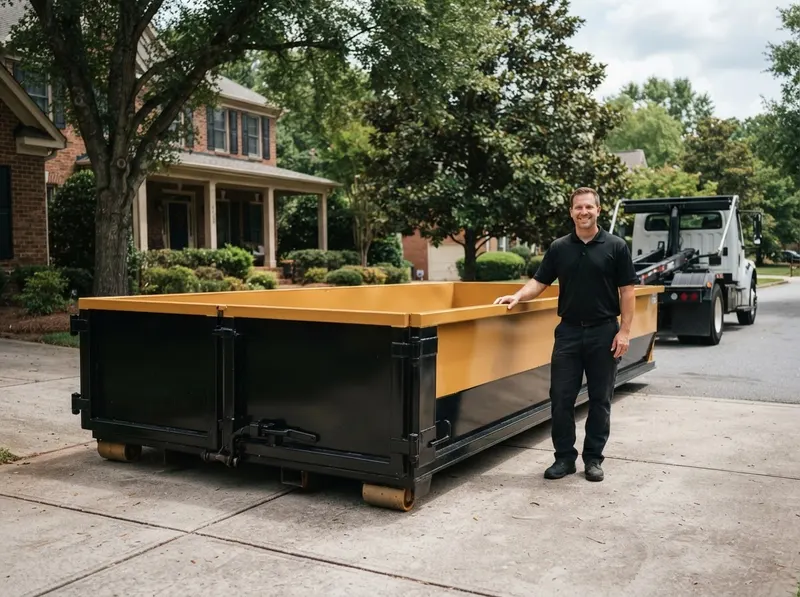
Managing heavy structural refuse requires dedicated jobsite logistics that comply with Mecklenburg County Solid Waste regulations. Remodeling projects along historic avenues in Dilworth or full gut-rehabs in NoDa produce thousands of pounds of aggregated waste that municipal curbside trucks cannot legally handle. A heavy-gauge construction roll-off container isolates raw structural materials, preventing hazardous nails, splintered pine, and brittle plaster from scattering across active work zones. SwiftStone Hauling Co. stages heavy containers on protective wood runners to eliminate surface friction and protect stamped concrete or fresh asphalt driveways from direct steel contact.
Demolition debris demands strict weight management that separates light interior clutter from structural matter. Placing pure masonry or dense earth into a large container risks exceeding legal transport thresholds monitored by the North Carolina Department of Transportation. For dense concrete, masonry, or foundation tear-outs near South End and Plaza Midwood, a compact 10-yard or 15-yard container prevents overloading, while whole-house renovations in Myers Park or framing rebuilds in Cotswold require the high-sidewall capacity of a 30-yard or 40-yard roll-off. Jobsite staging plans should align with OSHA construction safety standards by maintaining a minimum ten-foot operational perimeter around the drop zone for overhead delivery clearance.
Material handling on urban sites must observe local environmental and air quality standards. When handling drywall or insulation in older Elizabeth homes, contractors must comply with the EPA Lead Renovation, Repair, and Painting Program rules as well as regional guidelines outlined by the North Carolina Division of Waste Management. Diverting clean dimensional lumber and architectural metals through regional sorting centers aligns with the U.S. Green Building Council LEED certification diversion criteria. SwiftStone Hauling Co. hauls directly to authorized processing sites that follow the Construction & Demolition Recycling Association protocols to ensure sustainable reclamation.
Site access determines the right container choice for every Charlotte project. Narrow urban parcels near the Mint Museum Uptown or tight alleyways adjacent to Camp North End require accurate truck turning radiuses, whereas sprawling developments in University City and Ballantyne offer wide access pads capable of staging 40-yard boxes. Every deployment adheres to rules enforced by the City of Charlotte Department of Transportation regarding right-of-way staging, and waste streams must exclude regulated toxic materials listed under Earth911 hazardous material directories or the Agency for Toxic Substances and Disease Registry database.
Every job gets a firm, written price after a free on-site visit.
For standards, safe disposal, and service guidance on DUMPSTER in Charlotte, NC, useful references include U.S. EPA, EPA, EPA, OSHA, Earth911, and Google Maps. General consumer and small-business resources are available from USA.gov, Better Business Bureau, FTC Consumer Advice, U.S. Small Business Administration, and Ready.gov.
Tell us about your construction & demolition debris containers job in Charlotte and we'll send a clear, written quote, usually the same day.
 SwiftStone Hauling Co.